
How to Collect and Respond to Member Feedback



You send the survey. Twelve people answer. You file the results away. Six months later, you send another survey.
Sound familiar?
Most membership organizations aren't struggling to collect member feedback. They're struggling to improve member feedback from a box-checking exercise into a system where it actually does something. There's a meaningful difference between the two, and it explains why so many well-intentioned listening efforts quietly collapse.
Done right, member feedback becomes your organization's clearest signal on member value and where improvements are needed.
This article walks through how to fix that: from designing surveys members will finish, to the response practices that shape a stronger member experience, to the one habit that turns member voices into visible change.
Key Takeaways
- Nearly 40% of associations have no regular feedback loop, yet organizations that build one see measurable gains in retention, engagement, and trust.
- Survey fatigue is rarely about frequency. It's about asking questions that never lead to visible action.
- The best time to ask is tied to a lifecycle moment: onboarding, post-event, pre-renewal, or right after cancellation.
- Low response rates don't just mean fewer data points. They mean your least-engaged members, often the ones closest to leaving, go completely unheard.
- Every survey question should connect to a decision your team can act on. If you can't act on the answer, don't ask it.
- "Anonymous" and "confidential" are not the same thing. Members share more when they know exactly who sees their response.
- Closing the loop publicly, telling members what changed because of their input, is the single most effective way to improve future response rates.
- Join It is rated Excellent on Trustpilot and gives you the member profiles, survey integrations, and communication tools to collect, track, and act on member feedback all in one place.
Why Most Member Feedback Efforts Quietly Fail
Here's the honest starting point.
According to ASAE's membership research, nearly 40% of associations have no regular member feedback loop at all. Only 11% feel their value proposition is "very compelling" to members. These two numbers are almost certainly connected.
ASAE describes the core problem as "inaction fatigue." It's the disillusionment that sets in when feedback is collected and then nothing changes. Members answer once, notice the silence, and stop answering. The organization interprets low response rates as member apathy. It's actually member cynicism, and it's earned.
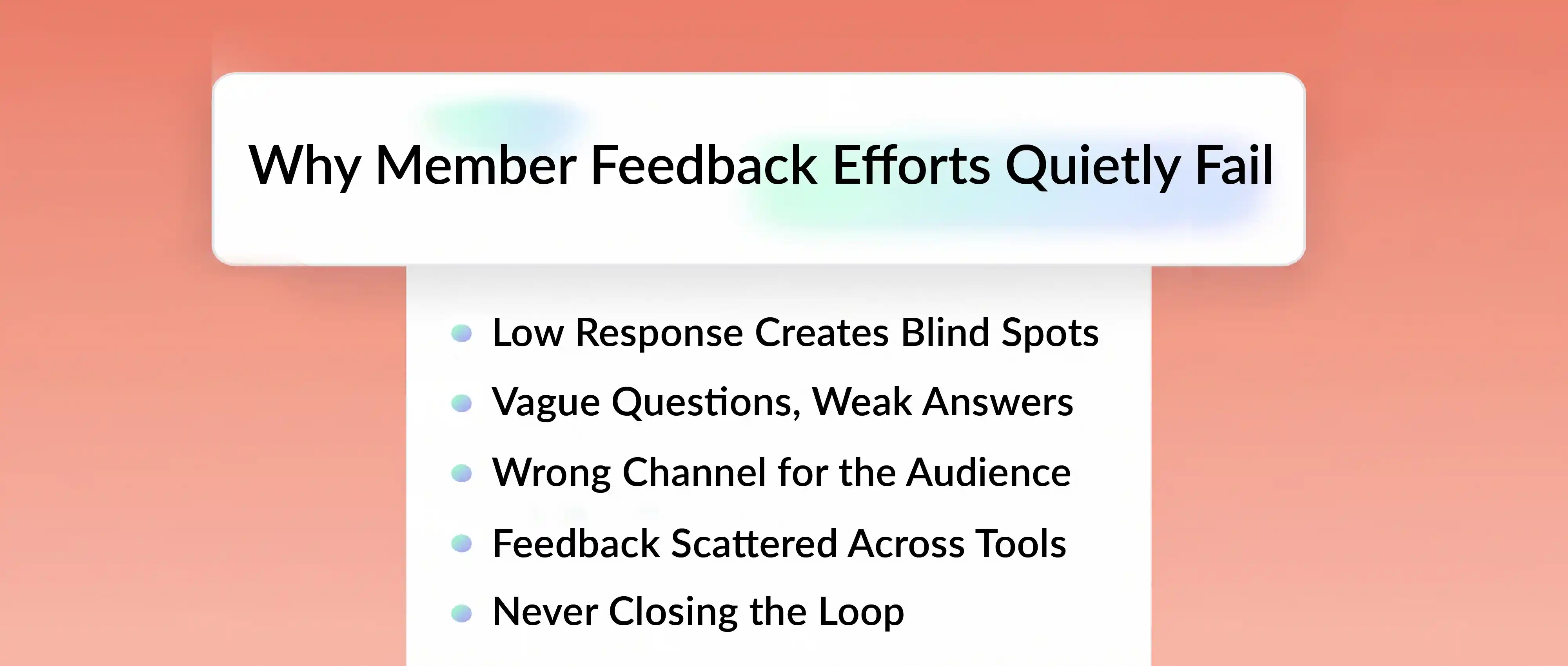
Five patterns show up repeatedly in organizations where feedback programs stall:
Response rates that create blind spots. The Mountaineers, a 14,400-member organization, called their 16% response rate high, noting that the industry generally considers a 2-3% rate to be a strong result. In one nonprofit Reddit thread, a volunteer reported only 11 replies from 2,000 emails sent. Low participation doesn't just mean fewer data points. It means quieter, less-engaged members, often the ones closest to leaving, go completely unheard.
Vague questions that produce unusable answers. "How satisfied are you overall?" is a question that sounds useful but points to no specific decision. Every question in your survey should connect to something your team can actually change.
Channel mismatch. Email-only collection works well for some members and reaches very few others. Younger members, mobile-first members, and those in local chapters or low-tech environments often need a different route entirely.
Fragmented data. One federation's 17 member associations were each running their own separate CRM systems, websites, and email platforms before consolidating. Feedback scattered across event forms, inboxes, and spreadsheets is nearly impossible to analyze or act on systematically.
Never closing the loop. A member in one HOA thread described it plainly: "member feedback is often ignored." If members don't hear what changed because of their input, they stop providing it. Trust erodes fast when effort feels pointless.
The fix starts before you write a single survey question.
Start With the Decision, Not the Survey
AAPOR, the leading professional association for survey researchers, makes this point clearly: clarify the objective before collecting anything, and explicitly ask whether a survey is even the right method.
For a membership organization, every feedback request should be tied to a real decision. Are you trying to improve first-year retention? Redesign your flagship event? Understand why a specific member segment isn't renewing? Identify unmet professional development needs?
If you cannot name the decision the feedback will shape, you are not ready to ask.
This also means keeping listening separate from selling. Surveys that include fundraising asks, promotional language, or agenda-driven questions undermine credibility immediately. AAPOR is direct on this: surveys should not be used for campaigning, fundraising, or selling. Members notice the difference, and once they do, they stop participating.
To manage members in one place and connect feedback to actual member profiles, you need infrastructure that makes this practical, not aspirational. Without it, good intentions get lost in inboxes.
How to Collect Member Feedback Across the Lifecycle
The right time to ask is almost never "whenever the calendar has space."
Triggered feedback, tied to specific moments in the member lifecycle, consistently outperforms mass surveys because it's relevant to something the member just lived through. Here are the moments that matter most:

New member onboarding survey. Send this around the 3-6 month mark. Ask what they expected, what they have actually used, what's getting in their way, and what their communication preferences are going forward. This is your earliest signal for first-year churn, and it comes when there is still time to intervene. You can send surveys when members join or become inactive automatically, so no new member slips through unheard.
Pulse survey. Short, focused, and frequent enough to stay current without overwhelming members. FEDESSA ran fortnightly single-question polls to gradually build member profiles, asking one targeted question at a time. The word "gradually" matters here. Slow accumulation beats a 30-question annual form.
Event feedback survey. Collect this immediately after the event, while the experience is still fresh. Wait a week and you have lost the signal. For post-event feedback to be useful, your member events feedback flow needs to be automatic, not something someone remembers to send on Friday afternoon.
Renewal intent survey. This goes out before the renewal deadline, not after. The goal is to surface value gaps while there is still time to address them. A member who feels unheard as membership renewals approach is a lapsed member in waiting.
Member exit survey. Ask immediately after cancellation. Not a week later. A short lapsed member survey plus an optional personal call will tell you more about your retention problems than a year of pulse surveys. To understand why members cancel, you have to create a path where leaving members can actually tell you.
On method: email surveys cover the broad base. Phone or video calls work best for departing members and high-value members who need personal attention. Website pop-ups catch members in the moment of an action. SMS polls reach mobile-first audiences. The goal is always to meet members where they already are, not to add friction to the asking.
How to Design a Survey Members Will Actually Finish
When figuring out how to create a member satisfaction survey, the first honest truth is this: most surveys are too long.
AAPOR recommends short questionnaires, one concept per question, and plain language throughout. Pew Research adds a specific mobile-first warning: poor mobile design leads directly to skipped questions, lower-quality data, and abandoned surveys mid-way.
The practical rules that matter most:
- Five to seven questions maximum for pulse and event surveys
- Mostly closed-ended questions (Likert scales, multiple choice, yes or no) for speed
- One or two open-ended questions for the "why" behind the numbers
- No sliders, no grid questions, nothing that breaks on a phone screen
- Tell members upfront how long it takes: "This takes three minutes"
On how to collect anonymous member feedback: when you're asking about leadership trust, staff behavior, finances, or internal conflict, AHRQ research shows that people are significantly more candid when they know their responses cannot be traced back to them. When asking about leadership trust, staff behavior, finances, or internal conflict, make anonymity explicit. "Your responses are completely anonymous" is not the same as implying it.
One more step most organizations skip: pretest the survey before launch. Show it to two or three staff members and one friendly member. What confuses them will confuse everyone.
For nonprofit membership survey questions and association-specific examples, the guide to membership survey questions covers each survey type in detail.
The Best Membership Survey Questions by Use Case
Here are member satisfaction survey examples organized by the decision each one is meant to inform, along with the most useful questions to ask members for feedback at each stage:
New member onboarding survey:
- Why did you join, and is that expectation being met so far?
- Which benefits have you actually used since joining?
- What's been the biggest barrier to getting more involved?
Pulse survey (one or two questions maximum):
- How valuable has your membership felt this month, on a scale of 1 to 10?
- What is one thing we could do differently right now?
Event feedback survey (post-event survey questions for members):
- How relevant was today's content to your current priorities?
- How likely are you to attend a similar event in the future?
- What would have made this better?
Renewal intent survey:
- How likely are you to renew your membership this year?
- What would make renewing feel like an easy decision?
Member exit survey:
- What was the primary reason for your decision to leave?
- Was there a specific moment when your mind started to change?
- Is there anything we could have done differently?
Every question should connect to a decision your team can actually make. If you cannot act on the answer, do not ask. That single rule eliminates more bad survey questions than any other.
How to Improve Membership Survey Response Rates
Here is the uncomfortable benchmark: external online surveys average 20-30% response rates, according to Clootrack. For membership surveys, it is often considerably lower.
The Mountaineers called 16% high, in an industry where 2-3% is considered a strong result. One nonprofit volunteer reported 11 replies from 2,000 emails. These are not outliers.
What genuinely moves response rates in the right direction:
Ask at the right moment. Triggered feedback consistently outperforms mass surveys because relevance is built into the timing. A post-event survey sent the same evening the event ended will always outperform one sent the following Thursday.
Explain why you are asking. A short line in the invitation, something like "Your answers will directly shape our programming for next year," dramatically increases completion. Members want to know their time matters before they spend it.
Keep it genuinely short. Not "shorter than last year." Short as in five questions that take three minutes. That is a different standard.
Be thoughtful about cadence. Survey fatigue is a real problem, and it compounds quickly when members receive too many requests in a short window. Guidance on how often you communicate with members applies directly to feedback requests: more frequent is not better when it comes to surveys.
Prove past feedback led somewhere. This is the single most underrated response rate strategy. When members see their previous input reflected in a real decision, they answer the next survey. Because they know it counted.
You can send surveys automatically at the right lifecycle moments using Join It's SurveyMonkey integration, removing the manual effort from well-timed outreach.
How to Respond to Member Feedback and Complaints
Collecting feedback without responding is like opening mail and never replying. Knowing how to act on member feedback is where the real work begins.
The Victorian Ombudsman's guidance on complaint handling sets a useful standard: acknowledge within three business days, explain the process clearly, clarify what outcome the member is hoping for, and resolve simple issues at the frontline before escalating complex ones to someone more senior and independent.
One thing most membership organizations miss: members rarely use the word "complaint." They say things like "this doesn't seem right" or "I thought we were supposed to get access to that." Train your staff and volunteers to recognize that language as feedback that needs routing, not dismissing.
When you do respond, be honest, specific, and human:
- Thank them for telling you
- Summarize what you heard
- State what you found or decided
- Explain the next step, and if no change is possible, explain why
To track member details in one place and log every feedback interaction, a CRM connected to your member data turns scattered individual conversations into patterns your team can actually act on.
ISO 10002, the international standard for complaint handling, frames this as a continuous improvement process, not a one-off response. Analyze feedback for recurring themes. Identify the root cause. Change the thing causing the complaint so the next member doesn't face the same issue.
"You Said, We Did": The Most Underused Habit in Membership
ASAE recommends a formal practice they call "You Said, We Did." The concept is straightforward: after you act on feedback, you tell your members exactly what changed and why.
Here is what it looks like in practice:
"You told us our conference sessions ran too long. We've shortened every session to 45 minutes and added a dedicated Q&A block at the end."
That's it. Specific, honest, directly connected to what members said.
ASAE's research shows that publishing these updates consistently builds trust and, more practically, increases future survey response rates. Members who see their feedback reflected in real decisions are far more likely to answer the next time you ask. They are also far less likely to quietly let their membership lapse.
For this to work at scale, email marketing for membership programs needs to be consistent and well-timed. A "You Said, We Did" buried in a monthly newsletter competes with twelve other items. A standalone, focused update lands differently.
Don't only share the wins. When a suggestion isn't feasible, say so and say why. "You asked for a mentorship program. We're exploring it for next year and need three volunteer coordinators to make it work. Here's how to get involved." Transparency about "not yet" is almost as powerful as "yes, we did it."
What Happens When You Get the Feedback Loop Right
The pattern is consistent across membership organizations of every size. When member data is scattered, feedback gets lost, communication becomes inconsistent, and retention quietly erodes. When it comes together, the results are measurable.
One European federation consolidated data from 17 separate association systems into a single member view and built a consistent listening and communication cycle around it. The outcomes:
- Member retention climbed from 85% to 94%
- Survey participation increased by 29%
- Email engagement jumped by 320%
- Event attendance grew by 29%
- 50% of members began renewing two months early
- Admin time dropped by 12 hours per week
The driver was not a single survey. It was centralized data connected to a repeatable feedback cycle.
The same principle shows up with Join It organizations.
Cosley Zoo, a member-based wildlife facility in Illinois, was managing memberships across disconnected systems with no unified view of its members. After centralizing with Join It, the results were clear:
- Membership grew by 80%
- Staff time dropped because information no longer lived across multiple documents
- Records became accurate and member communication became consistent
Their membership coordinator put it simply: better tracking led directly to easier, more consistent communication with members, and that communication drove the growth.
That consistent communication is exactly where a feedback loop becomes possible. When you know who your members are, when they joined, what they have attended, and whether they have renewed, you can ask the right question at the right moment. When you respond visibly to what you hear, members stay longer.
Using member engagement software to track how engagement shifts after feedback-driven changes is what turns a one-time improvement into a repeatable cycle.
To improve member retention with the same data-driven approach, the specific levers connecting feedback to renewal decisions are worth understanding before you send your next survey.
A Simple 30-Day Plan for Small Teams
You don't need 17 CRMs to start. You need four weeks and one clear focus.
Week 1. Choose one specific decision your organization actually faces right now. Who needs to weigh in? What will you do with different types of answers? Write those answers down before you open any survey builder.
Week 2. Build one short member feedback survey, five questions maximum, and set up an always-on feedback form on your website. Create a shared log where every piece of feedback, survey responses, complaints, event comments, and informal mentions, lives in one place.
Week 3. Send the survey to one defined segment, not your entire list. Review early results in 48 hours, not at the end of the month. You are looking for patterns, not individual outliers.
Week 4. Acknowledge responses. Fix one quick, visible thing. Send a brief "You Said, We Did" update to the people who participated. This is the step that makes the next survey worth sending.
After that first cycle, a monthly review of complaints and suggestions, a quarterly pulse survey to a defined segment, and an annual member survey or member needs assessment become the rhythm.
For member engagement ideas that can come directly out of this feedback cycle, you'll find specific program and communication ideas that map to what members typically tell you they want.
For follow-up after collection, simple member communication tools make the response step practical for small teams without dedicated communications staff.
And if scattered spreadsheets are still making it hard to connect feedback to member profiles, membership management software that centralizes your member data is often the missing link between hearing something and actually doing something about it.
Frequently Asked Questions
What is a member satisfaction survey?
A member satisfaction survey is a structured questionnaire that measures how well your organization is meeting member expectations. It typically covers perceived value, benefit usage, communication quality, and renewal intent. It is different from a member needs assessment survey, which focuses on future priorities, and from a pulse survey, which is shorter and runs more frequently.
How often should associations run member satisfaction surveys?
Most associations benefit from one broader annual association member survey, supported by shorter pulse surveys tied to specific lifecycle moments or events. Running a full survey more than once a year typically increases survey fatigue without improving the quality of the responses you receive.
Should member surveys be anonymous or confidential?
Anonymous means no one can connect the response to the individual. Confidential means only specific people can see identifiable responses. Use anonymous collection when asking about leadership trust, staff behavior, internal conflict, or finances. AHRQ research confirms that people are more candid when they know their responses cannot be traced back to them personally.
How do you close the feedback loop with members?
Closing the loop means telling members what you heard and what you did with it. Publish a "You Said, We Did" update in your newsletter or member portal after every major feedback cycle. When a suggestion isn't feasible, explain why. The goal is for members to see that responding was worth their time, so they respond again.
What should you do after collecting member feedback?
Centralize all responses in one log. Tag them by theme: benefits, communication, events, policy, or service. Segment member survey results by join date, engagement level, and renewal status to find the patterns that overall averages hide. Prioritize by impact and mission fit. Then close the loop publicly before the next survey goes out.
Can surveys predict renewal behavior?
Yes, with important limits. Renewal intent surveys sent before the deadline surface at-risk members while there is still time to intervene. Combining renewal intent scores with engagement data, event attendance, email opens, and benefit usage, gives a more reliable picture than any single question alone.
Ready to put this into practice? Book a call with the Join It team to see how a connected feedback system works for a real membership organization. Or start a free trial and explore how Join It helps you collect, organize, and act on member feedback without the spreadsheet chaos.
Sources
- ASAE. The Membership Model Is Breaking Down — Here's How Associations Can Rebuild It
- ASAE. You Said, We Did: The Key to Boosting Survey Responses and Trust
- The Mountaineers. 2022 Member & Volunteer Survey Results
- Reddit. r/nonprofit — Board member feedback thread
- Join It. Cosley Zoo: 80% Membership Increase Case Study
- Reddit. r/HOA — Member feedback ignored thread
- Clootrack. Average Survey Response Rate in 2025

Guides from the Experts
Through our work with 4,000+ organizations - we’ve put together helpful guides to assist; regardless of where you are on your journey.
.webp)

A Complete Guide to Membership Organizations
Everything you need to know to manage and grow your membership business
.webp)
Maximize Membership Retention: 10 Proven Strategies
Tried and true strategies that not only win membership, but keep them

Build a Membership Website: A Step-by-Step Guide
Your one-stop resource for knowing all the features your modern membership website needs
Ready to start your free trial?
Our membership software is intuitive to use and even easier to test for yourself.






.svg)
.svg)

